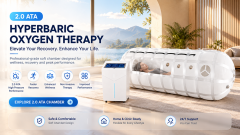
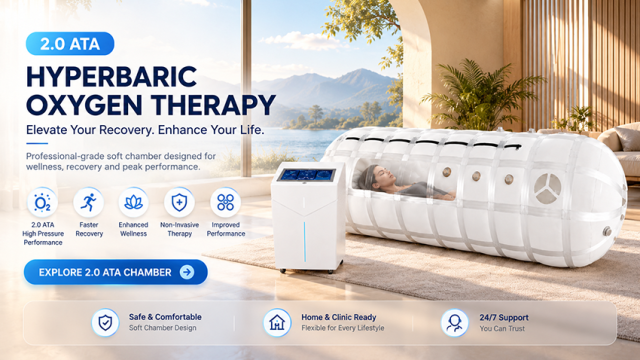
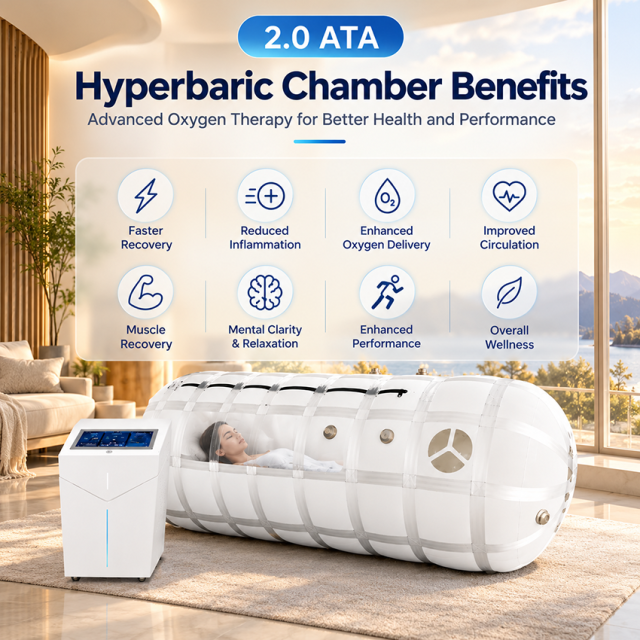
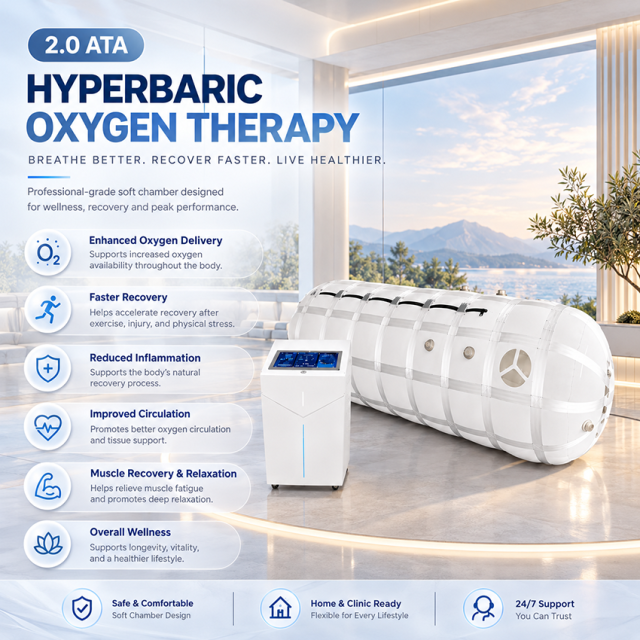

2.0 ATA Hyperbaric Oxygen Chamber – Professional HBOT System for Advanced Oxygen Therapy & Recovery
High-Pressure Oxygen Therapy | Tissue Oxygenation | Clinical Recovery | Professional Wellness Solutions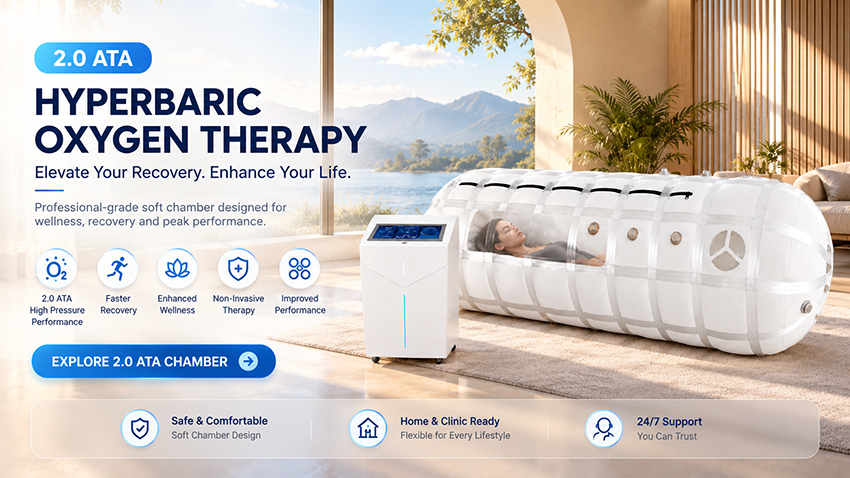
Hyperbaric Oxygen Therapy (HBOT) involves breathing oxygen inside a specially designed chamber where atmospheric pressure is increased above normal levels.
At 2.0 ATA (Atmospheres Absolute), the chamber operates at twice the normal atmospheric pressure at sea level.
Under increased pressure, breathing high-concentration oxygen raises the amount of oxygen dissolved in blood plasma, helping oxygen reach tissues where circulation and oxygen delivery may be compromised.
This process follows Henry's Law: the amount of gas dissolved in a liquid increases as the partial pressure of that gas increases.
The therapy process involves three key stages:
Controlled Pressurization: The chamber gradually increases pressure to the prescribed treatment level, up to 2.0 ATA.
Enhanced Oxygen Dissolution: Breathing medical-grade oxygen under pressure increases dissolved oxygen in the bloodstream.
Controlled Decompression: Pressure is gradually returned to normal following the treatment protocol.
The therapeutic effect depends on both chamber pressure and the concentration of oxygen actually delivered to the patient.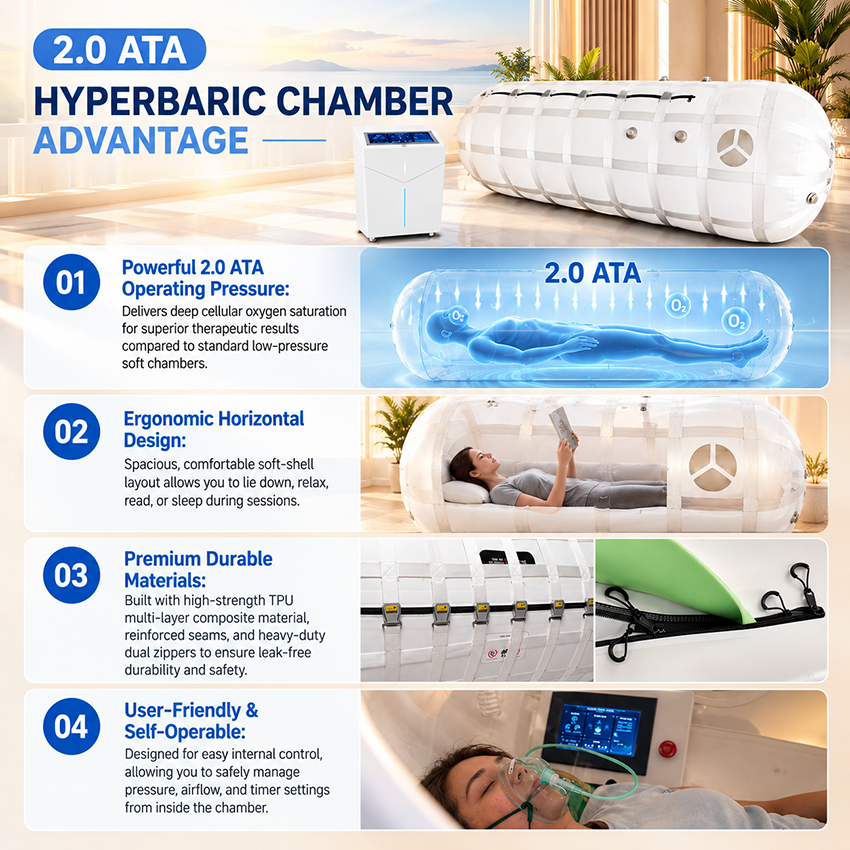
1. Professional 2.0 ATA Hyperbaric Pressure
Operating at up to 2.0 ATA, the chamber provides a higher-pressure treatment environment than typical 1.3 ATA wellness chambers, supporting protocols that require greater hyperbaric pressure.
2. Enhanced Dissolved Oxygen Delivery
Increased oxygen partial pressure can significantly raise oxygen dissolved in blood plasma, supporting oxygen availability in tissues beyond what is achievable through normal atmospheric oxygen breathing.
3. Pressure and Oxygen Concentration Work Together
Unlike ordinary oxygen inhalation at atmospheric pressure, HBOT combines elevated environmental pressure with oxygen administration to increase the amount of oxygen physically dissolved in plasma.
4. Supports Evidence-Based Hyperbaric Applications
When used with appropriate oxygen delivery and medically supervised protocols, hyperbaric therapy has established applications in selected conditions involving compromised tissue oxygenation, certain non-healing wounds, and radiation-related tissue injury.
5. Controlled Compression and Decompression
A professionally designed hyperbaric system allows pressure changes to be managed gradually, supporting patient comfort and reducing pressure-related risks when operated correctly.
|
Application |
Potential Value |
|---|---|
|
Tissue Oxygenation |
Increases oxygen availability in blood plasma during HBOT |
|
Wound Care Support |
May support healing in selected chronic or difficult-to-heal wounds |
|
Post-Surgical Tissue Recovery |
May be used for specific compromised grafts or flaps under clinical supervision |
|
Radiation Tissue Injury |
Supports selected medically indicated hyperbaric treatment protocols |
|
Inflammation Management |
May influence certain inflammatory responses in specific clinical contexts |
|
Recovery Medicine |
Provides a controlled hyperbaric environment for appropriate recovery protocols |
|
Rehabilitation Support |
May complement medically supervised rehabilitation where HBOT is indicated |
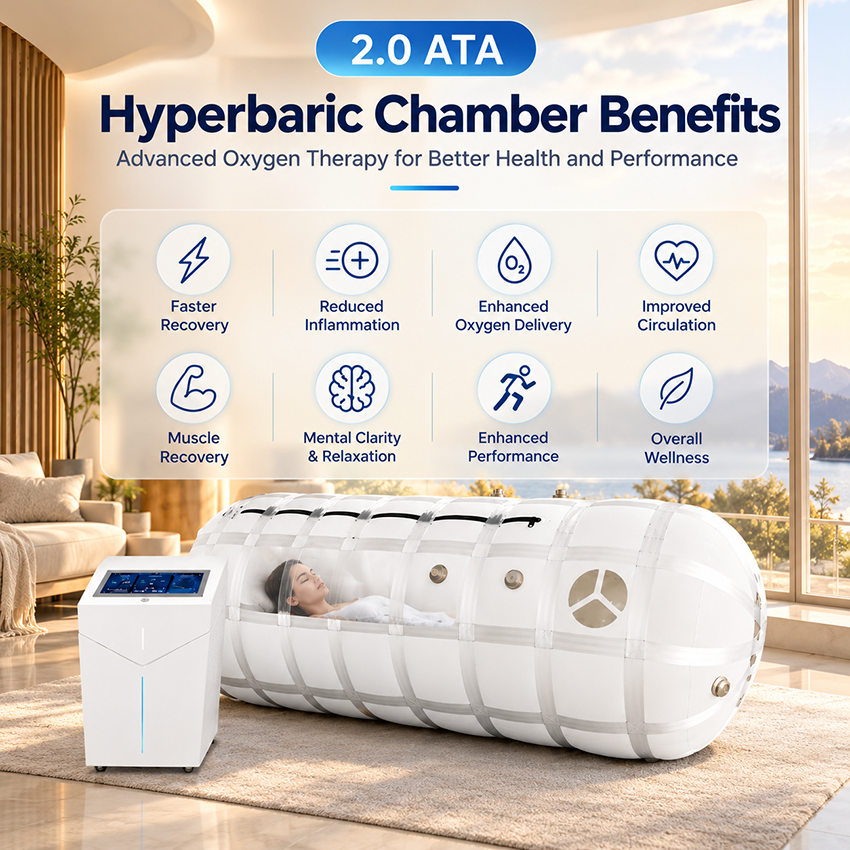
A 2.0 ATA Hyperbaric Chamber offers healthcare facilities an opportunity to expand their treatment portfolio while developing a differentiated, professionally managed hyperbaric service.
1. Expand Professional Service Offerings
Introduce hyperbaric oxygen therapy into eligible wound care, rehabilitation, and specialist treatment programs, subject to applicable regulations and medical supervision.
2. Build Long-Term Treatment Revenue
Many medically indicated HBOT protocols involve multiple sessions, creating opportunities for structured treatment scheduling and recurring service revenue.
3. Differentiate Your Facility
Position your clinic with a higher-pressure hyperbaric solution rather than relying exclusively on lower-pressure wellness chambers.
4. Support Patient Referrals
Develop referral relationships with qualified physicians, wound care specialists, and other healthcare providers for appropriate hyperbaric treatment indications.
5. Improve Equipment Utilization
A well-organized appointment system can support predictable chamber utilization, efficient staffing, and long-term equipment value.
Suitable for medically supervised hyperbaric treatment services and selected clinical indications.
Supports specialized programs for eligible non-healing wounds and compromised tissue conditions.
Rehabilitation & Recovery Centers
An option for qualified facilities incorporating physician-prescribed HBOT into multidisciplinary care.
Premium Wellness & Longevity Centers
Potentially suitable for facilities with appropriate medical oversight, equipment certification, and permitted treatment programs. General anti-aging benefits remain unproven.
Q1: What is the difference between a 2.0 ATA hyperbaric chamber and a 1.3 ATA chamber?
A 2.0 ATA chamber operates at twice normal sea-level atmospheric pressure, while a 1.3 ATA chamber operates at 1.3 times atmospheric pressure. The higher pressure can increase oxygen partial pressure and dissolved oxygen levels when appropriate oxygen is administered. However, chamber pressure alone does not establish clinical HBOT equivalence.
Q2: How long does a typical hyperbaric oxygen therapy session last?
Clinical HBOT sessions commonly involve approximately 90–120 minutes of oxygen breathing at pressure. Total appointment time may be longer because of compression, decompression, and preparation. Duration and pressure must follow a prescribed treatment protocol.
Q3: Does a 2.0 ATA chamber deliver 100% oxygen?
Not necessarily. The chamber's pressure rating and the oxygen concentration delivered to the patient are separate specifications. Depending on chamber design, medical-grade oxygen may be supplied through a mask, hood, or an approved oxygen-pressurized system. Buyers should verify the actual oxygen delivery method and concentration.
Q4: Who is suitable for hyperbaric oxygen therapy?
HBOT may be prescribed for selected medical conditions, including certain difficult-to-heal wounds, radiation-related injuries, and compromised grafts or flaps. A qualified physician must assess suitability, including contraindications such as untreated pneumothorax, and determine the appropriate treatment protocol.
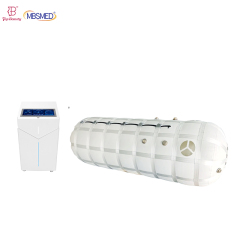
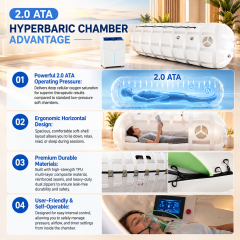
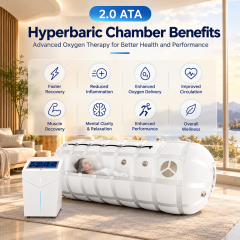
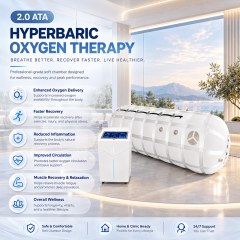
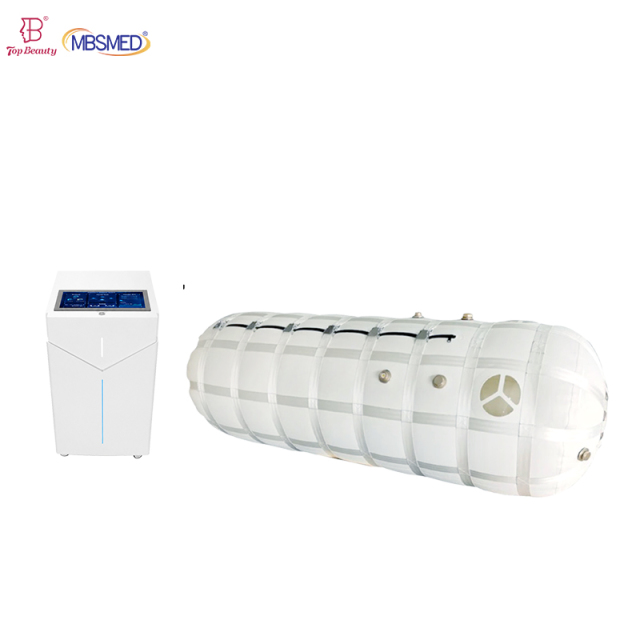
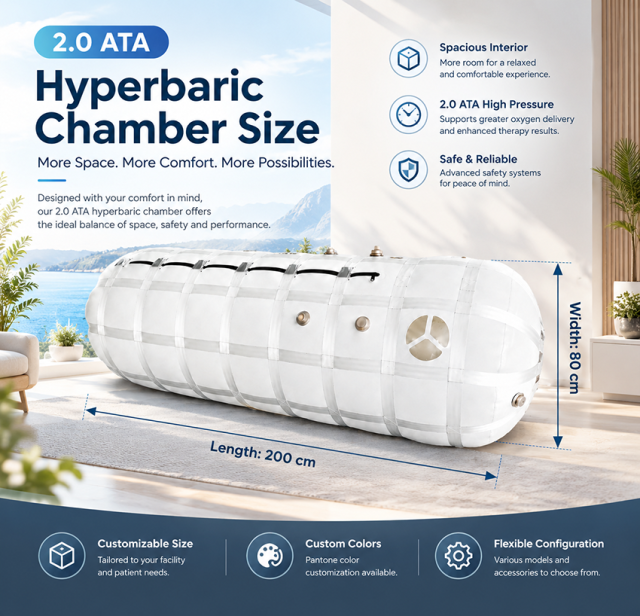
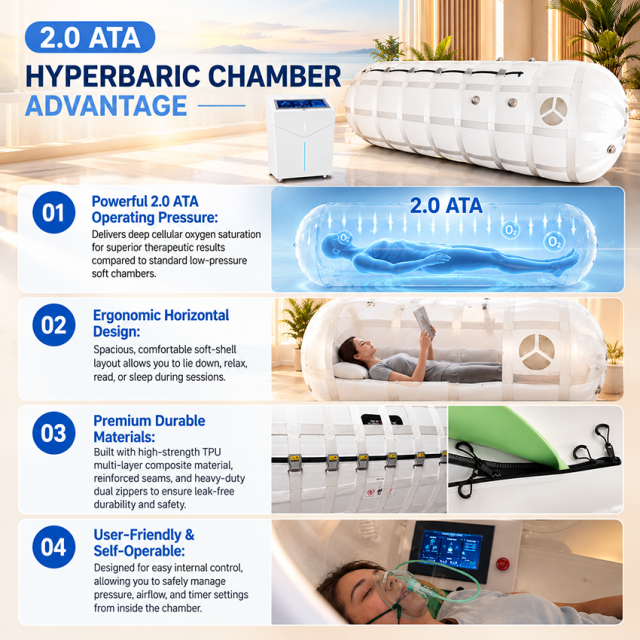
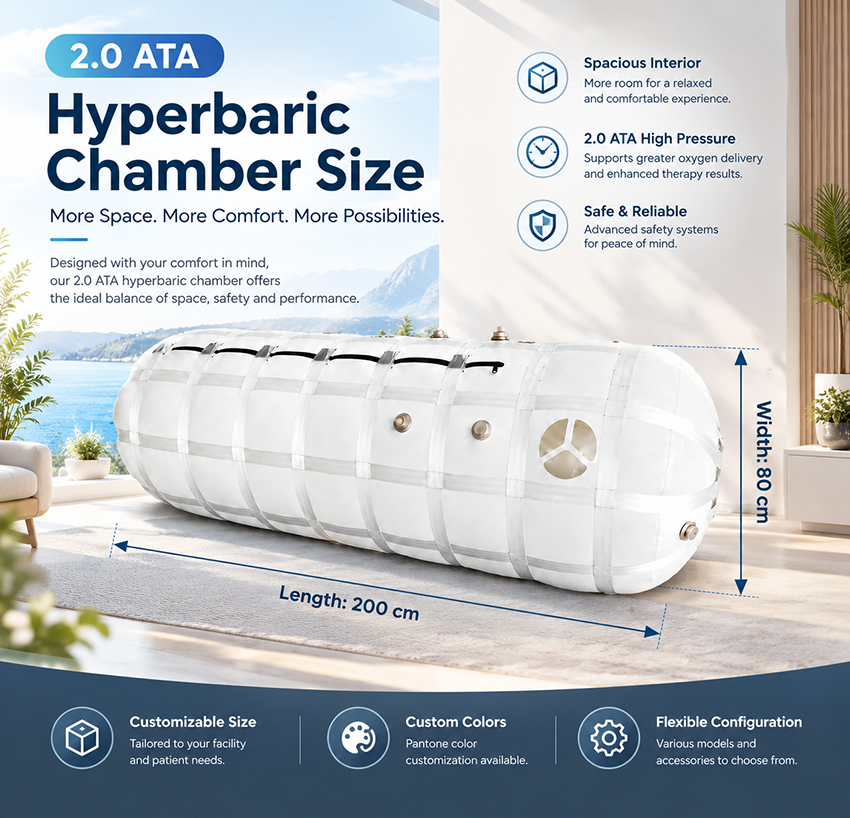
This soft shell hyperbaric oxygen chamber is built around an inflatable TPU cabin that holds a working pressure of up to 2.0 ATA. The cabin is long enough for a client to lie back through the session rather than sit upright for the whole treatment. A clear circular port in the shell lets the operator keep the client in view at all times, and the zip closure along the top makes entry and exit simple for people who are uneasy in enclosed spaces.
Control is split between two positions. The client has a control point inside the cabin and the operator works from the console outside, so pressure changes and session timing can be handled from either side without opening the shell. The cabin body is white TPU with metal pressure valves, and it deflates when the room needs to be cleared or the unit moved to another site. The host cabinet combines the air compressor and the oxygen concentrator in one unit, which means the system installs as two pieces — cabin and console — instead of a built-in construction project.
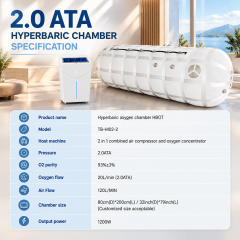
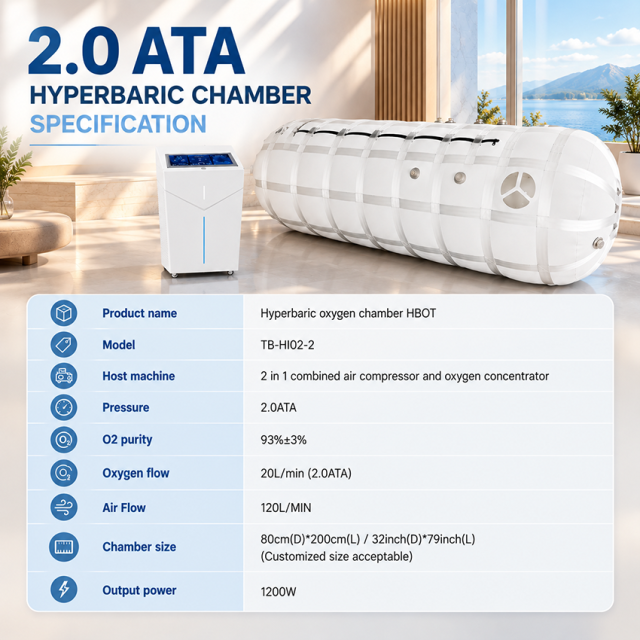
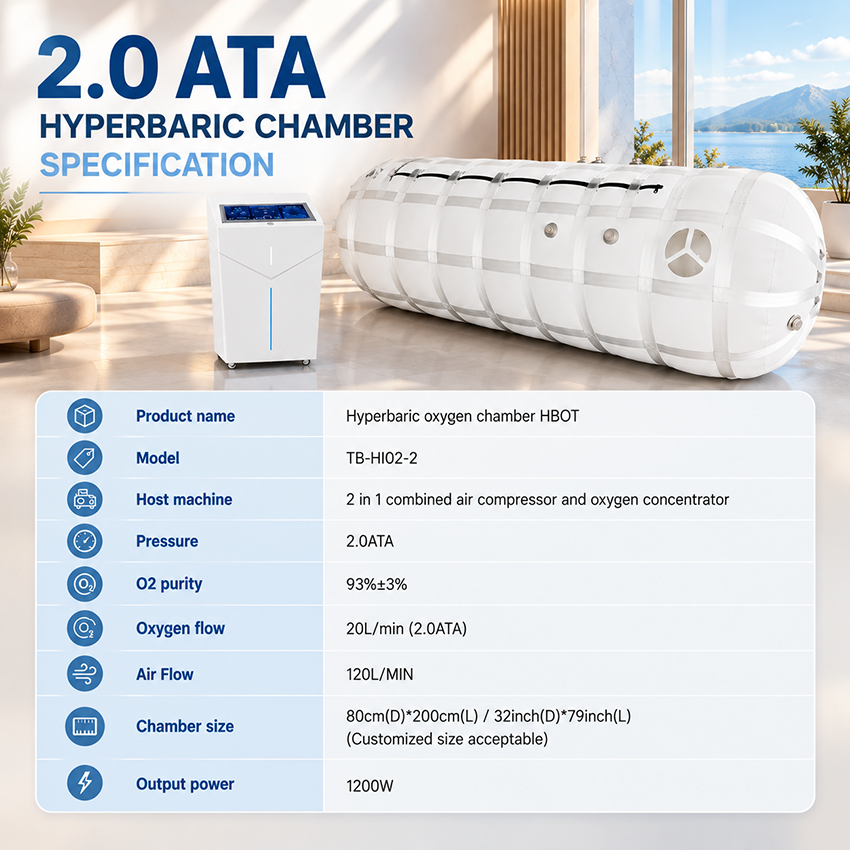
Oxygen is specified at 90% ± 3 concentration, with an oxygen flow rate of 15 L/min and an air flow rate of 120 L/min. The model is produced in 1.3 ATA, 1.5 ATA and 2.0 ATA versions; the 2.0 ATA build on this product is the one chosen by facilities that want headroom for higher-pressure protocols. It suits clinics, rehabilitation and recovery centres, and works as a 2.0ata hbot cabin for home use in supervised home-care rooms where a trained operator runs every session.
| Application | Potential Value |
| Tissue Oxygenation | Increases oxygen availability in blood plasma during HBOT |
| Wound Care Support | May support healing in selected chronic or difficult-to-heal wounds |
| Post-Surgical Tissue Recovery | May be used for specific compromised grafts or flaps under clinical supervision |
| Radiation Tissue Injury | Supports selected medically indicated hyperbaric treatment protocols |
| Inflammation Management | May influence certain inflammatory responses in specific clinical contexts |
| Recovery Medicine | Provides a controlled hyperbaric environment for appropriate recovery protocols |
| Rehabilitation Support | May complement medically supervised rehabilitation where HBOT is indicated |
| Property | Value |
|---|---|
| Chamber pressure | 2.0 ATA |
| Pressure versions | 1.3 ATA / 1.5 ATA / 2.0 ATA |
| Oxygen concentration | 90% ± 3 |
| Oxygen flow rate | 15 L/min |
| Air flow rate | 120 L/min |
| Chamber material | TPU |
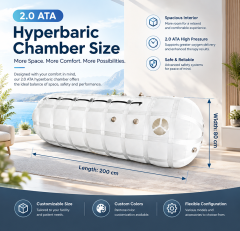
| Cabin dimensions | 80 cm (D) × 200 cm (L), approx. 32 in × 79 in |
| Cabin entry | Zip closure along the top |
| Viewing | Clear circular observation port |
| Host unit | Combined air compressor and oxygen concentrator |
| Intended settings | Clinic treatment rooms and supervised home-care rooms |
A 2.0 ATA hyperbaric chamber is capital equipment, and its business case rests on utilisation — how many sessions a room can realistically host each week, and who prescribes them.
Broaden the service menu. Hyperbaric oxygen therapy slots into eligible wound care, rehabilitation and specialist programs, subject to the regulations that apply where you operate and to medical supervision. For a clinic already running physiotherapy or wound care, it extends a treatment plan you already deliver rather than starting a separate business from scratch.
Recurring sessions rather than one-off visits. Many medically indicated protocols call for a series of sessions. That turns a single course of treatment into a scheduled sequence of appointments, which is what makes planning staffing and room time realistic.
A higher-pressure option on your own floor. Facilities that have relied on lower-pressure wellness chambers can offer a 2.0 ATA environment instead of referring higher-pressure work out. That difference is often what a referring physician checks first.
Referral relationships. Wound care specialists and physicians who prescribe hyperbaric treatment send clients where the equipment and the supervision are both credible. Those relationships take time to build, and a chamber of this class is what makes them possible.
Utilisation and staffing. A booking pattern that groups similar protocol lengths — longer courses earlier in the day, shorter recovery sessions later — keeps the cabin busy without overloading one operator. Predictable utilisation is what protects the long-term value of the equipment.
The provider behind the machine. Uptime is part of the return. Choosing a hyperbaric oxygen chamber provider that answers technical questions quickly and understands the protocol workflow matters as much as the pressure figure on the label.
With 16 years in the industry, Top Beauty keeps engineering, design and sales teams under one roof, so technical questions reach the people who actually build the machines. Before you order, our engineers help you match a model to your intended use and the way you plan to run it. After delivery we stay involved: installation and commissioning guidance, operator walkthroughs, and troubleshooting by email or video call, answered quickly and patiently. OEM and ODM projects run the same way, from first specification through to final sign-off.
A 2.0 ATA chamber runs at twice normal sea-level atmospheric pressure, while a 1.3 ATA chamber runs at 1.3 times. The higher pressure can raise oxygen partial pressure and the amount of oxygen dissolved in plasma when appropriate oxygen is administered, which is why protocols needing more pressure are run in a 2.0 ATA cabin. Chamber pressure alone does not establish clinical HBOT equivalence, though — the oxygen concentration delivered and the prescribed protocol matter just as much. This model is produced in 1.3 ATA, 1.5 ATA and 2.0 ATA versions so a facility can match the pressure class to the work it intends to do.
Clinical sessions commonly involve around 90 to 120 minutes of oxygen breathing at pressure. The appointment runs longer than that, because compression, decompression and preparation all take time around the treatment period. Duration and pressure follow the prescribed protocol rather than the maximum rating of the cabin.
Not necessarily. Pressure rating and delivered oxygen concentration are two separate specifications. This model is listed at 90% ± 3 oxygen concentration with an oxygen flow rate of 15 L/min feeding the cabin, and how that reaches the client depends on the delivery method — a mask, a hood or another approved delivery setup. Verify the delivery method and the measured concentration for the configuration you buy instead of assuming the pressure rating tells you.
Treatment may be prescribed for selected medical conditions, including certain difficult-to-heal wounds, radiation-related tissue injuries and compromised grafts or flaps. A qualified physician assesses each client, checks for contraindications such as untreated pneumothorax, and sets the pressure and duration. Suitability is a clinical decision: the chamber provides the controlled environment, and the facility must operate within the regulations that apply where it is installed.
Yes, under conditions. Supervised home care works where a trained operator runs each session, the room meets the power and ventilation requirements, and a clinician oversees the program. A 2.0 ATA HBOT cabin for home use is not a self-service device — the operator role is the same as in a clinic, simply in a smaller setting.
The cabin is a soft shell hyperbaric oxygen chamber that zips along the top. The client lies back on the interior padding, the operator closes the zip, and the session begins. A clear circular port lets the operator watch the client from outside without opening the cabin, which makes first sessions easier to manage for clients who are unsure about being enclosed.
Wipe the TPU interior and the zip area with the surface disinfectant your clinic already uses for treatment rooms, then let the cabin dry fully before it is zipped closed. Check that your chosen disinfectant is compatible with TPU before routine use, since some strong solvents dull the material, and clean the observation port with a non-abrasive cloth. Anything the client touches should follow your own infection-control protocol.